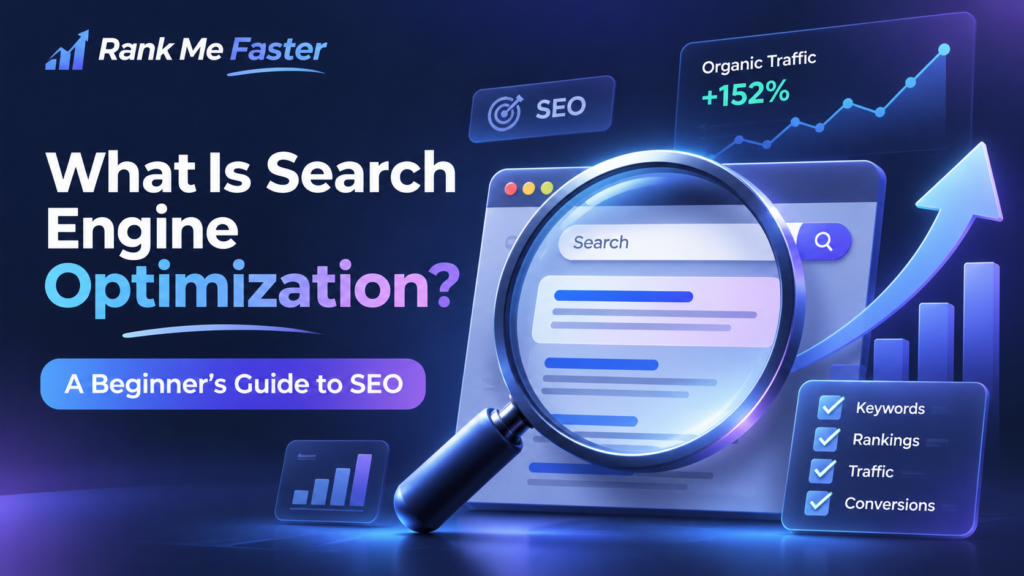
If your business has a website, you have probably heard the term search engine optimization. But what does SEO actually mean, and how can it help your business grow?
Search engine optimization, commonly known as SEO, is the process of improving a website so it can appear more prominently in search results when potential customers search for relevant products, services, or information.
For businesses, effective SEO can mean more visibility, more qualified website traffic, and more opportunities to generate leads and customers without relying entirely on paid advertising.
In this guide, we will explain how SEO works, what professional SEO services include, and why search engine optimization has become an important part of modern digital marketing.
What Is Search Engine Optimization?
Search engine optimization is the practice of improving different parts of a website so search engines can better understand its content and determine when it should appear in search results.
When someone searches Google for a product, service, or question, Google evaluates many different signals before deciding which pages should appear near the top.
These signals can include:
- Website relevance
- Content quality
- Page structure
- Website speed
- Mobile usability
- Internal linking
- Backlinks
- User experience
- Search intent
- Website authority
A strong SEO strategy improves these areas so your website has a better chance of appearing for searches that are relevant to your business.
Why Is SEO Important?
Most people use search engines when they need information, want to compare options, or are ready to purchase a product or service.
If your business does not appear when potential customers search for what you offer, those customers may find one of your competitors instead.
Professional SEO services are designed to improve your visibility at these important moments.
SEO can help your business:
- Increase organic website traffic
- Reach people actively searching for your services
- Improve brand visibility
- Build credibility and authority
- Generate more qualified leads
- Reduce long-term dependence on paid traffic
- Support sustainable digital growth
Unlike advertising that stops when you stop spending, strong SEO can continue generating visibility over time.
How Does Google Search Engine Optimization Work?
Google’s goal is to provide users with useful and relevant search results.
When Google discovers a website, its systems crawl the pages, analyze the content, and add eligible pages to its index.
When someone performs a search, Google then evaluates indexed pages and determines which results are likely to be most useful.
Google search engine optimization helps make your website easier for Google to crawl, understand, and evaluate.
This does not mean manipulating search engines. Good SEO is primarily about creating a technically sound website, useful content, clear information, and a positive experience for visitors.
The Main Types of SEO
Search engine optimization includes several areas that work together.
On-Page SEO
On-page SEO focuses on optimizing the content and structure of individual website pages.
This may include:
- Page titles
- Headings
- Meta descriptions
- Keyword targeting
- Website copy
- Images
- Internal links
- URL structure
- Search intent
The goal is to make each page clear and relevant for both search engines and visitors.
Technical SEO
Technical SEO focuses on how well search engines can access, crawl, understand, and index a website.
Common technical SEO areas include:
- Website speed
- Mobile responsiveness
- Crawling issues
- Indexing problems
- Broken links
- XML sitemaps
- Website architecture
- HTTPS security
- Duplicate content
- Core Web Vitals
Even strong content may struggle to rank if significant technical problems prevent search engines from accessing the website properly.
Off-Page SEO
Off-page SEO focuses primarily on signals outside your own website.
One of the most important elements is backlinks.
A backlink is created when another website links to your website. High-quality and relevant links can help demonstrate authority and credibility.
Off-page SEO can also include:
- Brand mentions
- Digital PR
- Industry citations
- Online partnerships
- Reputation signals
Local SEO
Local SEO is especially important for businesses that serve customers in specific geographic areas.
Examples include contractors, home service companies, restaurants, dentists, law firms, and other local businesses.
Local SEO can involve:
- Google Business Profile optimization
- Google Maps visibility
- Local keyword targeting
- Business citations
- Reviews
- Location pages
- Accurate business information
The goal is to help nearby customers find your business when they search for services in their area.
What Does an SEO Company Do?
An experienced SEO company analyzes your website, competitors, target customers, and search opportunities before developing a strategy.
SEO agencies may provide services such as:
- Keyword research
- Competitor research
- Technical SEO audits
- On-page optimization
- Content strategy
- Local SEO
- Link building
- Performance tracking
- Website optimization
- Conversion recommendations
The exact strategy should depend on your business rather than following the same approach for every website.
A good SEO company should focus on more than rankings.
The real objective should be attracting relevant visitors who have a genuine possibility of becoming customers.
What Does an SEO Specialist Do?
An SEO specialist works on improving website performance in organic search results.
Their responsibilities may include analyzing rankings, researching keywords, identifying technical problems, optimizing content, reviewing competitors, and monitoring search performance.
An SEO specialist may work independently, inside a company, or as part of an SEO agency.
What Is an SEO Consultant?
An SEO consultant typically provides strategic advice about how a website can improve its organic search performance.
A consultant may:
- Audit a website
- Identify SEO problems
- Develop a strategy
- Recommend keywords
- Review website structure
- Analyze competitors
- Create an SEO roadmap
Some consultants focus mainly on strategy, while SEO companies often combine strategy with implementation.
What Is SEO Marketing?
SEO marketing uses search engine optimization as part of a broader digital marketing strategy.
Instead of thinking about SEO only as rankings, SEO marketing focuses on connecting search visibility with business goals.
For example, ranking for a keyword is useful only if that keyword attracts the type of visitor your business actually wants.
A successful SEO marketing strategy therefore considers:
- Search volume
- Keyword intent
- Competition
- Customer behavior
- Website conversions
- Business profitability
This creates a stronger connection between SEO performance and actual business growth.
How Keyword Research Supports SEO
Keyword research helps identify the words and phrases people use when searching online.
For example, a homeowner may search:
“roof repair near me”
while another person may search:
“how much does roof replacement cost?”
These searches represent different intentions.
A strong SEO strategy identifies which searches are valuable and creates or optimizes pages that appropriately answer those searches.
Keyword research can help determine:
- What services customers search for
- What questions people ask
- Which topics deserve dedicated pages
- Where competitors are ranking
- Which opportunities may generate qualified traffic
Why Content Matters for SEO
Content gives search engines information about what your website covers.
More importantly, content gives visitors the answers they need.
High-quality SEO content should be useful, clear, relevant, and written around real customer questions.
Examples include:
- Service pages
- Blog articles
- Frequently asked questions
- Location pages
- Buying guides
- Comparison articles
- Educational resources
Publishing content simply to add keywords is not enough.
The content needs to provide genuine value.
What Is SEO Website Optimization?
SEO website optimization involves improving both individual pages and the website as a whole.
For example, an SEO specialist may discover that a website has:
- Slow pages
- Poor mobile design
- Weak service-page content
- Missing page titles
- Broken internal links
- Duplicate pages
- Unclear navigation
Improving these problems can help both search engines and users understand the website more effectively.
SEO is therefore not just about keywords. The overall quality of the website matters as well.
How Long Does SEO Take?
There is no universal timeline for SEO.
Some improvements may appear relatively quickly, while competitive search terms can require several months of consistent work.
The timeline can depend on:
- Website age
- Existing authority
- Competition
- Technical condition
- Content quality
- Industry
- Keyword difficulty
- Previous SEO work
Businesses should generally treat SEO as a long-term growth strategy rather than expecting immediate results.
SEO vs Paid Advertising
SEO and paid advertising are both valuable, but they work differently.
Paid advertising can generate visibility quickly because businesses pay for ad placements.
SEO focuses on earning organic visibility over time.
Paid advertising may be useful for immediate lead generation, while SEO can help create a longer-term source of search traffic.
Many businesses benefit from using both together.
Paid campaigns can capture immediate opportunities while SEO builds sustainable organic visibility.
How to Choose Between SEO Agencies
There are many SEO agencies, and choosing the right one requires more than comparing price.
Before selecting an SEO partner, consider asking:
- How will you research our industry?
- How do you choose keywords?
- How will you measure results?
- Will we receive regular reports?
- What happens during the first few months?
- Do you provide technical SEO?
- Do you create or optimize content?
- How do you connect SEO with leads and revenue?
Be cautious of SEO companies that guarantee specific rankings.
Search rankings are influenced by many factors, and no legitimate company controls Google’s search results.
Common SEO Mistakes Businesses Make
Some common SEO mistakes include:
Targeting the Wrong Keywords
High search volume does not always mean a keyword is valuable.
The best keywords are relevant to your services and match the intent of potential customers.
Ignoring Technical Problems
Broken links, poor website speed, indexing problems, and mobile issues can negatively affect SEO performance.
Publishing Thin Content
Pages with very little useful information may struggle to compete against stronger resources.
Keyword Stuffing
Repeating keywords unnaturally does not create better SEO.
Keywords should appear naturally within useful content.
Ignoring Local SEO
Local businesses may miss valuable customers if they do not optimize their Google Business Profile and local search presence.
Focusing Only on Rankings
Traffic, leads, calls, form submissions, and revenue matter more than ranking for keywords that do not generate business.
Is Search Engine Optimization Worth It?
For many businesses, yes.
SEO can be especially valuable when potential customers regularly use Google to research or find the products and services you provide.
A successful search engine optimization strategy can help create a consistent source of qualified website visitors.
However, SEO works best when it is treated as an ongoing process rather than a one-time task.
Search behavior changes, competitors improve their websites, and search engines continue evolving.
That means businesses should continually monitor and improve their SEO presence.
Build a Stronger Search Presence With Rank Me Faster
Search engine optimization is not simply about getting more website visitors.
It is about making your business easier to discover when the right people are actively searching.
At Rank Me Faster, our SEO services combine keyword research, technical SEO, on-page optimization, content strategy, local search, and ongoing performance improvements.
Our goal is to help businesses strengthen their search visibility, attract more qualified traffic, and turn that visibility into measurable growth.
If you want to understand where your website currently stands, start with an SEO review and identify the opportunities that could make the biggest difference.
Get a Free SEO Audit